A lighthouse can be a line.
The older tower was never meant to guide a ship by itself. A navigator approaching Port Royal Sound looked for two lights: a low beacon near the ocean and, more than a mile behind it, the taller light that still stands on Hilton Head. When the lights appeared one above the other, the vessel was in the channel. When they separated, so did the safe course.
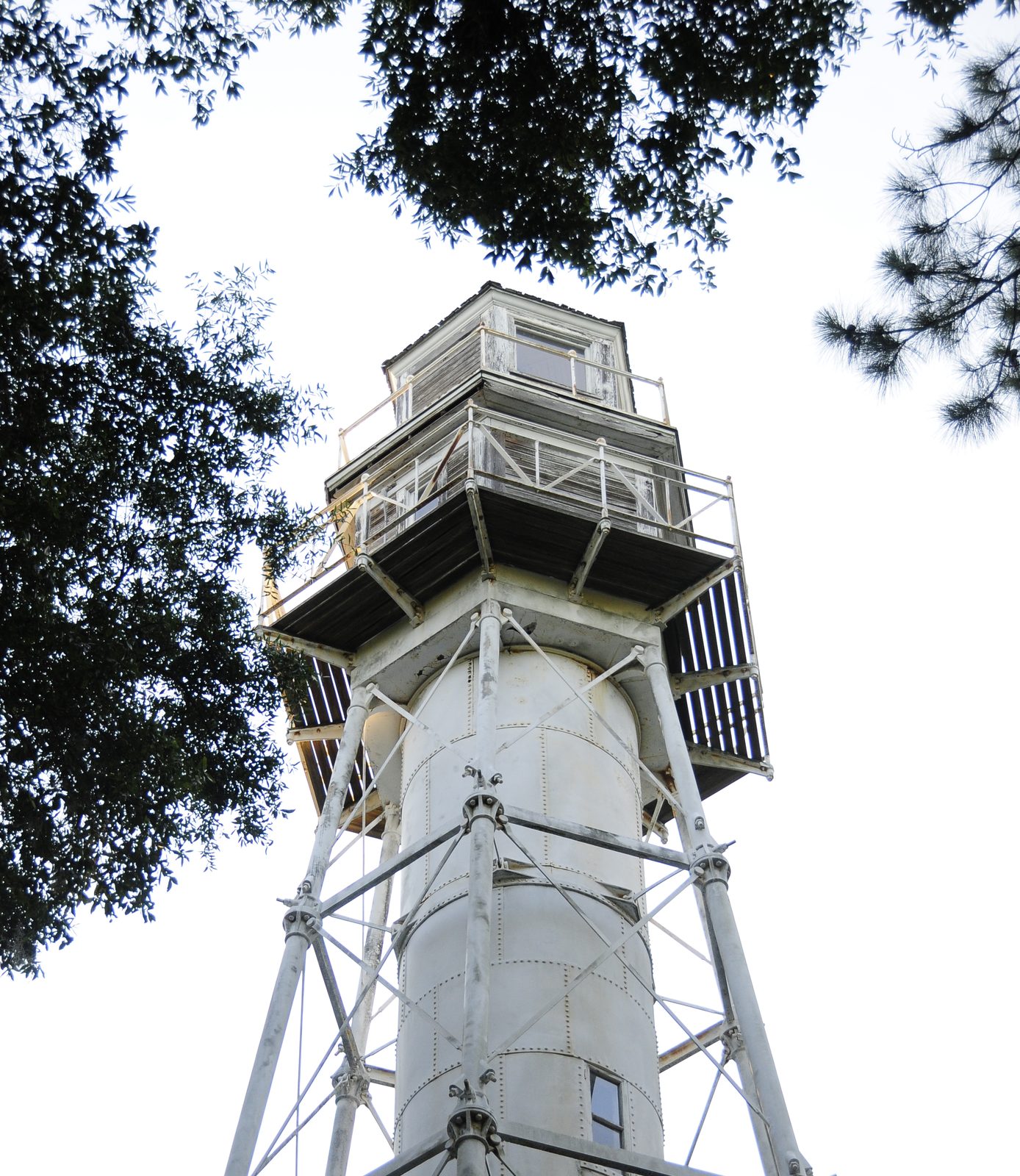
Hilton Head has two well-known towers, but only one began as federal navigation infrastructure. The cast-iron Hilton Head Rear Range Lighthouse at Leamington went into service in 1881. Harbour Town’s red-and-white tower was completed in 1970 as a privately built marker for Sea Pines; the Coast Guard now lists it as a private aid to navigation. The Blue Lady belongs to folklore. The records lead elsewhere, including to Renty Franklin Greaves, a documented assistant keeper of the range.
The channel kept moving, so in 1884 the front light was made movable. That structure is gone now. The rear light remains, its cast-iron frame rising beside the Arthur Hills golf course at Palmetto Dunes. The setting makes the tower look stranded, as though maritime history had taken a wrong turn onto the 15th hole.
In fact, the fairways are the newcomers.
A channel drawn in light
The National Register nomination traces the system to an 1876 congressional appropriation of $40,000. After delays over land and contracts, the U.S. Light-House Board completed both lights and their dwellings in June 1880. Activation waited until August 1, 1881, when the nearby Parris Island range lights would also be ready.
The rear structure was an elegant piece of industrial engineering: iron columns arranged around a central spiral stair, all fixed to six concrete foundations, with a wooden watch room and lantern above. Its focal plane stood 92 feet above sea level, and the light was visible from 15 miles away. A keeper’s dwelling stood nearby. An oil house, added in 1892, held the fuel that had to be carried up the tower.
The system adapted to a restless coast. As sand shifted the entrance channel, the front light was moved to preserve the alignment mariners needed. The rear tower remained fixed, a high point in a relationship rather than a solitary warning.
The range went dark in the 1930s. By the time the rear tower entered the National Register of Historic Places in 1985, its lantern hardware was gone, the front beacon had disappeared and the keeper dwellings no longer stood at the site. The Arthur Hills course opened around the tower in spring 1988. Infrastructure had become scenery, although the brick oil house and water cistern still keep the tower from standing entirely alone.
What the keeper records say about the Blue Lady
Then there is the Blue Lady.
The story changes with the teller. In a publisher-authorized excerpt from Terrance Zepke’s collection Ghosts of the Carolina Coasts, the keeper and his 16-year-old daughter are unnamed; both are found dead on the tower stairs after an undated hurricane. Current resort versions call them Adam and Caroline Fripp. Some kill Caroline within days or weeks. Others let her survive for years. Her dress is the one detail that never seems to change.
Later versions also appear to have fused two real storms. The National Weather Service records the catastrophic Great Sea Islands hurricane of 1893 as a Category 3 storm that killed at least 1,000 people, while a Category 1 hurricane made landfall on Hilton Head in 1898. Zepke’s version assigns no year.
The keeper roster that Palmetto Dunes says it derived from the U.S. Coast Guard Registry of Keepers offers different names. From 1891 to 1905, the appointed head keeper was Paul Schwarzer. William H. Blanding served as assistant from 1891 to 1899. No Adam Fripp appears among the appointed keepers. Because the roll records employees rather than households, it cannot establish whether a Caroline Fripp lived near the station. Its narrower finding still matters: Adam is not documented as the keeper the legend says he was.
National Archives historian Giselle White-Perry reconstructed the career of Renty Franklin Greaves from federal records. Greaves was born enslaved near Bluffton, served in the Union Army and later became a teacher, businessman and Beaufort County official. White-Perry’s research places him at Leamington from January 1882 through November 1887, earning $400 a year and tending the front range light. The station occupied land once held as Leamington Plantation; the resort later kept the name.
The same roster contains two women’s names, though neither belongs to the Blue Lady. Sarah E. Gillespie and Ann Calvert served as assistant keepers at Hilton Head’s earlier range lights in the 1860s. Their work survives in the least romantic form possible—a personnel list—while Caroline’s survives as a story.
The discrepancy moves the Blue Lady out of biography and into folklore. The work it imagines was real: oil carried up a long stair, a flame checked through the night, unseen vessels depending on somebody ashore. Later tellings turned that labor into a daughter’s promise and gave duty a color people could remember.
A ghost changes address
The tower stayed at Leamington. Sea Pines says the two keeper cottages did not.
According to the resort’s historic-sites account, both structures were moved to Harbour Town in the 1960s. One now contains the Harbour Town Bakery & Café; the other is used by Sea Pines Real Estate. The same account says that workers renovating the bakery cottage in 2020 uncovered the notation K. E. Kremser 1899 on a concealed board. Sea Pines identifies Kremser as a lighthouse-service sailor who served aboard the tender Pharos, which supplied the Hilton Head station.
The board supplies what the ghost story cannot: an inscription with a name and a date.
The Blue Lady traveled anyway. Local columnist David Lauderdale reported that Hilton Head teenagers were already using trips to look for her as a date-night pretext in the mid-1960s. Once the cottages reached Harbour Town, later tellings gave the ghost a second territory among its businesses. The buildings had crossed the island; the story followed without needing to choose one address.
The tower at the basin
Harbour Town’s striped tower began as an exercise in placemaking. The lighthouse’s published history says Charles Fraser asked Sasaki and Associates for a focal structure at the yacht basin—something that would pull the development into focus and register from Calibogue Sound and the golf course.
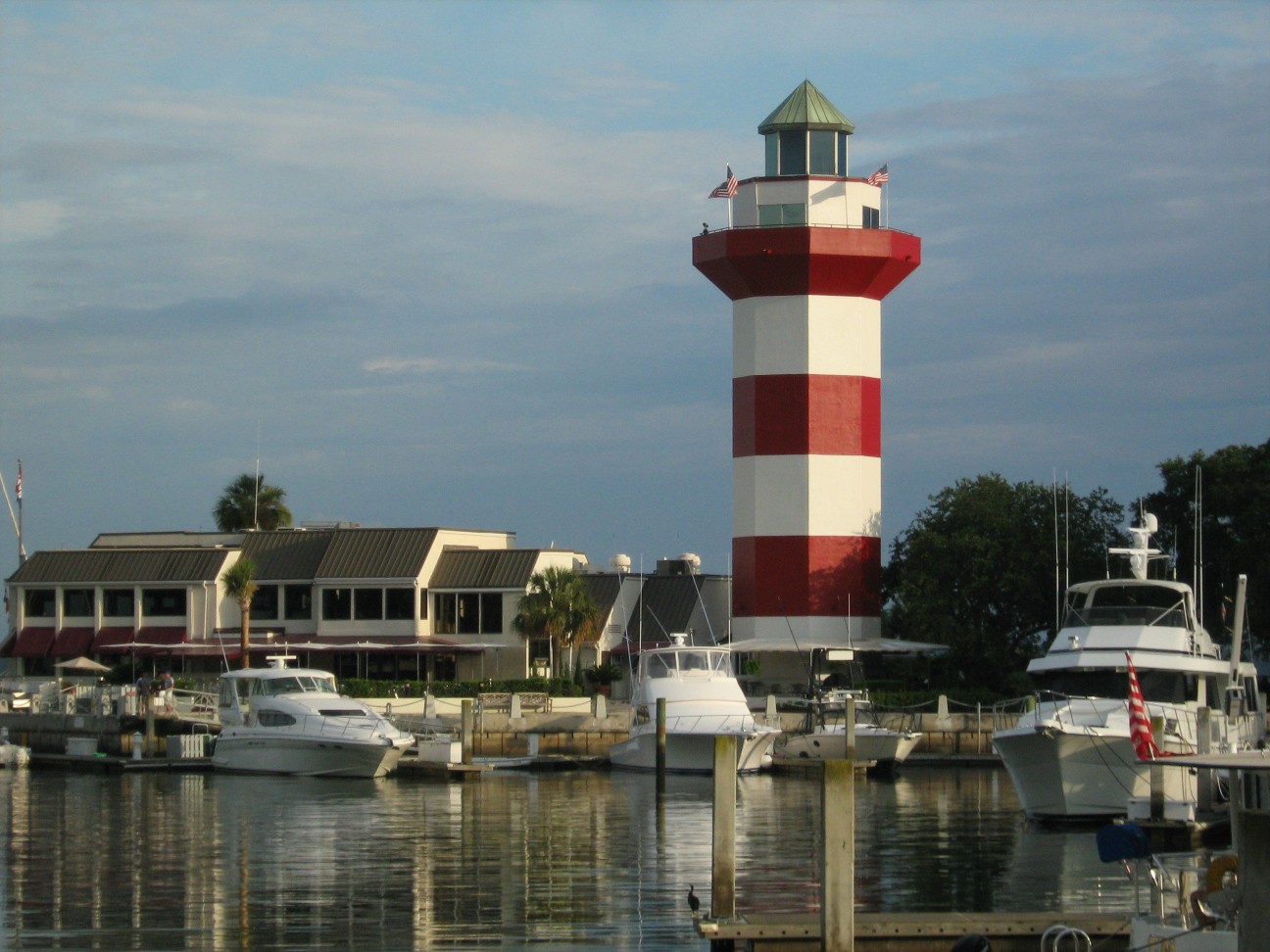

Harbour Town’s red-and-white landmark at the Sea Pines marina — a 1970 resort icon. Photo: MoodyGroove · CC BY-SA 3.0.

The tournament arrived before the finished building. When Arnold Palmer won the inaugural Heritage Classic in November 1969, only the lighthouse’s frame stood beyond the 18th green. Construction finished in 1970. As televised golf returned to Harbour Town, that striped backdrop became a national shorthand for the island.
It was conceived as a marker of place, not as a federal light station. It is more than decoration today, however: the Coast Guard’s Southeast District Light List dated August 12, 2026 records Harbour Town Lighthouse as private aid No. 4395, flashing white every 30 seconds. “Fake” is therefore an easy word and a poor one. The tower is an authentic work of twentieth-century resort design—114 steps, an observation deck, a museum—and identity was its founding brief.
Today the tower built as a symbol flashes white across the water every 30 seconds. The tower built for navigation stays dark beside a fairway. Hilton Head’s two lighthouses have traded some of their original work: the icon became an aid; the machine became memory.
Hilton Head’s two lighthouses, at a glance
| Detail | Hilton Head Rear Range Lighthouse | Harbour Town Lighthouse |
|---|---|---|
| Also called | Leamington Lighthouse | — |
| Location | Palmetto Dunes, beside the Arthur Hills golf course | Sea Pines, at Harbour Town Yacht Basin |
| Completed | June 1880; activated August 1, 1881 | 1970 |
| Original purpose | Federal rear range light guiding vessels into Port Royal Sound | Privately built landmark for Harbour Town |
| Current status | Inactive; historic tower and grounds preserved | Coast Guard-listed private aid; privately operated museum and observation tower |
| Documented staff in 1898 | Paul Schwarzer, head keeper; William H. Blanding, assistant | Not a federal keeper station |
| Can visitors climb it? | No. The grounds are visitable; the tower is closed. | Yes. There are 114 steps and an admission charge. |
| Blue Lady connection | The legend’s original setting, but no Adam Fripp appears in the appointed-keeper roster | The moved keeper cottages gave later versions of the legend a second address |
Plan the two-light visit
- Hilton Head Rear Range Lighthouse: 53 Leamington Lane in Palmetto Dunes. Visiting the grounds is free, but the tower is closed. Check current access and request a lighthouse pass at the Palmetto Dunes gate. Park only where directed; the site sits inside an active golf and residential community.
- Harbour Town Lighthouse: 149 Lighthouse Road in Sea Pines. The 114-step climb, museum displays and observation deck require admission; entry to Sea Pines may carry a separate charge. Check current lighthouse hours and access rather than relying on an old article.
Sources and further reading
- National Register nomination for the Rear Lighthouse of Hilton Head Range Light Station (1985)
- Rear Range Lighthouse history — Palmetto Dunes
- Original construction and range-light operation — Palmetto Dunes
- Hilton Head lighthouse keeper roster — Palmetto Dunes
- Arthur Hills course history — Palmetto Dunes
- Historic sites and the relocated keeper cottages — The Sea Pines Resort
- The Harbour Town Lighthouse’s design and construction — Harbour Town Lighthouse and Museum
- The Blue Lady as mid-century island folklore — The Island Packet
- Publisher-authorized “Lady in Blue” excerpt from Terrance Zepke’s Ghosts of the Carolina Coasts — AbeBooks
- Tropical cyclone history for coastal South Carolina and Georgia — National Weather Service
- Giselle White-Perry, “The Life of Renty Franklin Greaves,” Prologue, National Archives, Fall 2010: archives.gov
- Leamington Plantation history — Heritage Library
- Southeast District Light List, August 12, 2026 — U.S. Coast Guard
From the journal
Related stories
Ritual
The 5 a.m. walk
Hilton Head Island
The poles are in the sand before breakfast. The walk that put them there is not yours.
Place
The town they built
Hilton Head Island
After the Union took Port Royal, formerly enslaved people laid out a town here.
Ritual
How the Heritage took the island
Hilton Head Island
In 1969, Charles Fraser staged a golf tournament beside an unfinished lighthouse. Arnold Palmer gave it a headline. Hilton Head gave it permanence.